
TERMINAL EDIT — Issue No. 002
Detroit doesn’t ask for your approval.
Other cities perform for you — the welcome, the tourism infrastructure, the careful curation of first impressions. Detroit doesn’t do any of that. It exists entirely on its own terms. If you’re paying attention you’ll see what it is. If you’re not it’ll look like nothing and you’ll be wrong.
DTW runs on two terminals.
Evans and McNamara. McNamara is Delta’s operation — one of the airline’s most significant international hubs in the country. An express tram runs the length of the terminal, elevated above the concourse below — gates and travelers and the whole machinery of a major hub visible beneath you as it moves from one end to the other. It’s one of the better sixty seconds in American air travel and almost nobody talks about it.
Then there’s the Westin. Sitting inside the terminal itself like someone decided the airport was destination enough and built a hotel around that conviction. A room where the moving walkways are your lobby. Where aircraft push back from gates visible through your window. Where the entire machinery of departure becomes ambient sound. You check in and the airport is your neighborhood. You wake up and the first thing you hear is a city in motion.
There is no more of a TERMINAL EDIT hotel in America.
Evans handles everyone else. Together they make DTW one of the most capable and quietly respected airports in the country. Frequent travelers know this. Everyone else overlooks it — which is fitting for a city that has spent decades being underestimated.
The drive into downtown takes you through the industrial geography of a place that built the twentieth century and has spent the twenty-first figuring out what comes next. Detroit doesn’t hide this. The cranes, the construction, new glass rising next to old brick — all of it visible and unashamed. A city in the middle of something, wanting you to see it happen.
Kamper’s sits on the rooftop of the Book Tower.
Built in 1926. Twenty-two stories of Italian Renaissance architecture rising out of Washington Boulevard — terracotta facade, ornate cornice work, the specific grandeur of a building constructed by people who believed Detroit would be one of the great cities of the century. They weren’t wrong. They were just early on the timeline.
The Book Tower sat vacant for decades. Gutted by the same forces that gutted the city around it — population flight, economic collapse, the long slow unraveling of a place wound too tight around a single industry. For years it stood empty in downtown Detroit. An Art Deco monument in a city full of them. Beautiful and abandoned and refusing to fall down.
Then someone restored it. Brought it back. Turned the rooftop into a bar with fire pits and small plates and sweeping views of a skyline that looks nothing like it did when the building was new.
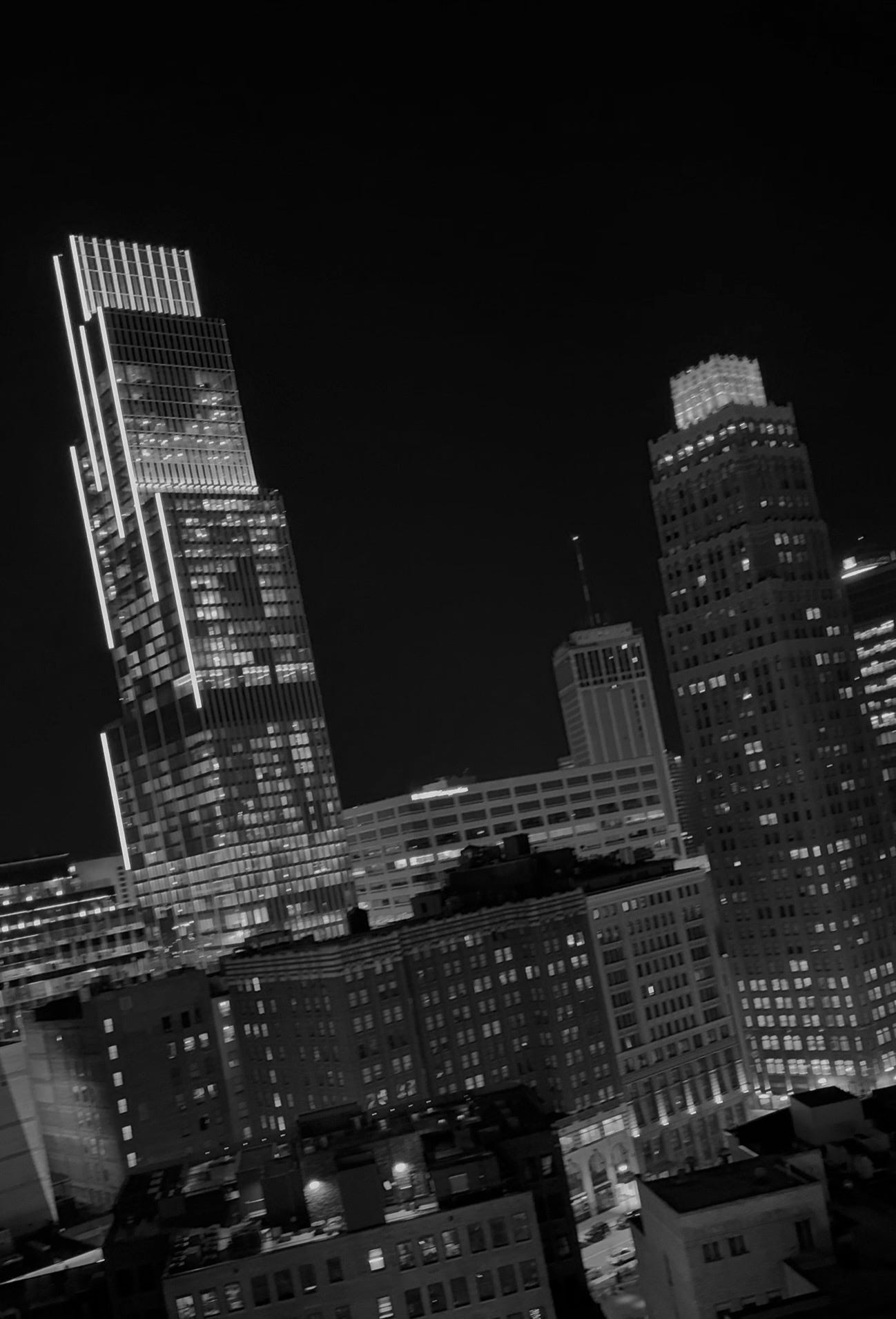
On a May night with Hudson’s Tower lit across the sky — Detroit’s newest statement, its declaration that the city is still capable of building things that mean something — Kamper’s rooftop is one of the better places to understand what this city is becoming. A century-old Art Deco tower holding the city’s newest ambitions on its roof. The old building refusing to become a ruin. The new skyline rising around it without apology.
The fire pits were lit. People sat around them with drinks watching a city decide who it wants to be next.
This is the contrast that defines Detroit right now. Everywhere you look — grandeur that survived and ambition that arrived late and the complicated negotiation between them happening in real time across every block of downtown. The city isn’t trying to erase what it was. It’s building on top of it. Literally. The bones of another era holding the weight of the next one.
There is something in that worth paying attention to.
Twenty miles north is Birmingham.
The drive up Woodward Avenue tells you everything about this region without saying a word. Downtown Detroit receding in the rearview. The neighborhoods changing mile by mile. Eight Mile Road passing beneath you like a line someone drew a long time ago that everyone still understands perfectly.
Birmingham is Oakland County money made physical. Manicured. Prosperous. The kind of suburb that has been comfortable for so long that comfort has become architectural. It is a different world from Detroit — deliberately, historically, uncomplicatedly so. That tension has defined this region for generations and nobody driving northbound on Woodward needs it explained.
None of which stopped us from having one of the better dinners of the year.
The Townsend Hotel sits at the center of Birmingham like it belongs there because it does.
Walking into the lobby is the specific experience of a hotel that has decided service is not a department but a disposition. Impressive without being ostentatious. Inviting in the way that only genuinely well-run hotels manage — the kind of inviting that comes from the people inside it rather than the design around them.
The staff operate on a simple principle: the word No is politically incorrect. Not as policy. As culture. The difference between those two things is everything. You feel it within minutes of arriving. The specific ease that settles over you in a place where the answer to whatever you need is always a variation of yes. No friction. No negotiation. Just the quiet confidence of a hotel that knows exactly what it is and has been doing it long enough that excellence has become effortless.
Breakfast at the Rugby Grille the next morning.
The room holds the entire social architecture of Oakland County in a single service. Business travelers buying time before the drive back south. Couples leaning across tables discussing real estate deals over eggs. Retirees who have been coming for thirty years and will come for thirty more. Old money stalwarts in their regular seats with their regular orders, reading the paper with the specific authority of people who have never needed to perform their comfort anywhere. The room has the quality of a place that has been important to people for a long time and knows it without needing to say so.
Then the pancakes arrived.
Fluffy center. Crispy edges. The specific pancake that makes every other pancake a lesser argument. The kind of dish that stops conversation not because there’s nothing to say but because what’s in front of you demands a moment of honest attention. There are meals you remember because of the occasion and meals you remember because of the food itself. These pancakes are the second kind.
The Rugby Grille at the Townsend. Best breakfast in Oakland County. Arguably the best pancakes in the world. That is not hyperbole. That is what happens when a hotel takes every detail seriously enough that even breakfast becomes an event.
La Strada sits in Birmingham like it has always been there and always will be.
Deep red walls. White tablecloths. The accumulated authority of a room that has fed serious people serious food for long enough that the confidence is structural rather than performed. You walk in and the room tells you immediately what kind of place this is. The kind that doesn’t need to tell you.
On the walls: a 1932 Travel magazine cover — an elephant, a rider, somewhere ancient and far away, 35 cents a copy. Next to it a large mixed media piece, layered and raw, the words Crime Must Pay bleeding through newsprint and color and halftone faces. Old world wanderlust next to urban provocation. The room holding both without explanation, the way this entire region holds its contradictions — present, unresolved, and entirely honest about it.
The lamb shank arrived and the conversation stopped.
That’s the test. When a dish arrives and the table goes quiet — not because there’s nothing to say but because the thing in front of you demands a moment of honest attention — that’s a kitchen doing something right. Braised until it surrendered completely. Deep sauce the color of something that has been cooking for a long time. Rosemary standing upright in the meat like a flag planted in territory fully conquered.
Birmingham rewards the drive. La Strada is why.
Lunch the next day was Besa. Downtown Detroit.
The room is minimal in the specific way that takes confidence to pull off. No art on the walls. No visual noise. Nothing competing for your attention except the food, the people, and the quality of the light. Tasteful lighting design that makes everything look considered. A room that earns its authority through restraint rather than accumulation — the opposite philosophy from La Strada and equally correct.
The crowd at lunch was the new Detroit made visible. When Rocket Mortgage chose downtown it changed who eats lunch in this city. The tables at Besa held that shift in real time — executives, people on dates, a new money crowd that chose downtown Detroit not because it was the obvious choice but because they saw something coming before it arrived. That’s a specific kind of person. Confident. Forward-facing. Willing to bet on a city still in the middle of proving itself.
The branzino came out grilled, sitting over romesco that knew its role — supporting rather than competing, letting the fish be the thing. Clean plate. Good lemon. The kind of lunch that makes the rest of the afternoon feel manageable because you started the right way.
Besa is where the next chapter of Detroit eats. Sit there long enough and you can feel the city shifting around you.
This is what 24 hours in Detroit gives you if you let it.
A rooftop on a restored Art Deco tower watching a new skyline rise against the night. A hotel in Birmingham where the word No doesn’t exist and the pancakes will rearrange your understanding of breakfast. A dining room holding a century of contradiction on its walls without apology. A downtown lunch room full of people who chose to believe in this city before the belief was easy.
Detroit has always been a city that builds things. Cars. Music. Architecture that embarrassed cities twice its size. It went through something that would have finished most places — the long decline, the bankruptcy, the national narrative of collapse that played on a loop for a decade — and it is coming out the other side with the specific dignity of a place that never stopped knowing what it was.
The cranes are running. The towers are going up. The rooftops are full.
Eight Mile Road still means what it has always meant to the people who live on both sides of it. That hasn’t changed and won’t change quickly. But downtown Detroit is filling up with people who are choosing the city deliberately — not despite its history but informed by it. That’s a different energy from the gentrification story that plays out in other American cities. Detroit’s story is more complicated. More earned. More honest about what it cost and what it’s still working through.
Which is exactly what this city has always been.
Not coming back. Never left. Just waiting for everyone else to catch up.
Next: A night inside the Westin at McNamara — the hotel that lives inside the airport.
Subscribe to TERMINAL EDIT. New essays every week.
Late flights. Strange cities. Rooms that don’t remember you. We write about that life. Honestly.
TERMINAL EDIT